



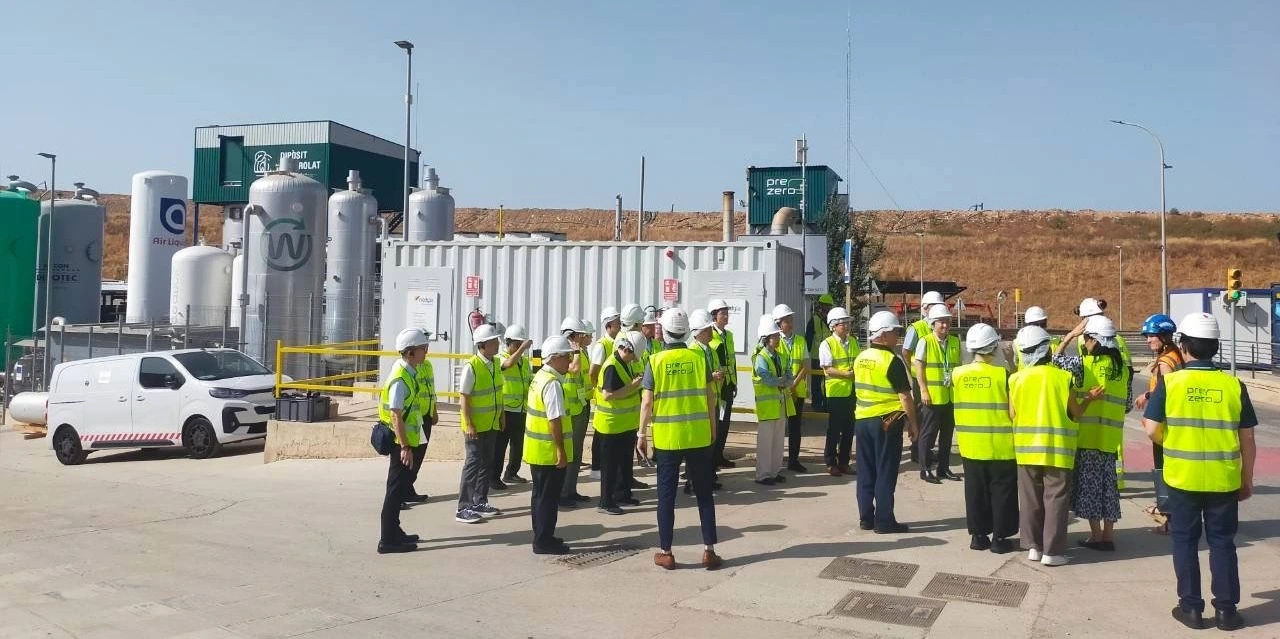
Nedgia’s commitment to promoting renewable gases and moving towards a more sustainable energy model has attracted the interest of gas sector professionals from various countries. A delegation from the Japan Gas Association (JGA) –an organisation representing Japan’s leading gas companies– recently visited the Can Mata site in Barcelona to see for themselves how green gas is being integrated into the distribution network.
The visit is part of a technical programme focusing on the most significant initiatives currently under development in Spain in the field of renewable gases, a form of energy set to play a key role in the energy transition. The delegation included representatives from Japanese gas distribution and supply companies, engineering firms, technology centres and research organisations keen to learn about real-world experiences of biomethane production and injection into the network.
During the event, attendees were able to learn about the Nedgia’s strategy to drive the growth of green gas and facilitate its integration into existing energy infrastructure. The company shared its experience in developing projects that harness organic resources to produce biomethane, a renewable gas with properties similar to those of natural gas, which can be distributed via existing networks without the need to modify user installations.
One of the highlights of the visit was a tour of the Can Mata injection module, a leading facility where the biomethane produced is fed directly into the distribution network. Thanks to this process, renewable energy generated from organic waste can be supplied to homes, businesses and industries using the same infrastructure that currently transports natural gas.
This solution helps to promote the circular economy by transforming waste into renewable energy and enables progress in reducing greenhouse gas emissions. It also favours greater energy independence and uses existing infrastructure, making biomethane a key tool for accelerating the decarbonisation of sectors that require efficient and competitive energy solutions.
The meeting also provided an opportunity to exchange views on the challenges and opportunities associated with the development of renewable gases. The Japanese representatives showed great interest in learning about aspects relating to plant operations, network injection processes, the regulatory framework and prospects for growth in the biomethane sector in Spain.
According to Ignacio Cabané, Head of Grid-Connected Biomethane Plants and Hydrogen Blending Projects at Nedgia, this type of event allows us to share knowledge and strengthen international collaboration on technologies that will be crucial to achieving decarbonisation targets.
“Integrating green gas into the network is now a reality and is already helping to transform the energy system. Sharing our experience with professionals from other countries enables us to foster the exchange of knowledge and move forward together towards a more sustainable future”, he emphasised.
Growing international interest in projects such as Can Mata highlights the role Spain is playing in the development of renewable gases and cements Nedgia’s position as a leading company in this field. With initiatives such as this, the distributor continues to promote innovative energy solutions that help build a more sustainable and efficient model, one that is better equipped to meet the energy challenges of the future.